FMEAs for flight hardware, drafted in minutes.
The draft does the typing. Your reliability engineers keep the judgment, the edits and the signature.
Graded against NASA's 1988 review: 10 to 11 of 14 failure modes fully matched in each run.
Rows and scores from the sample report. Review states shown for illustration.
Drafting
Describe the part. Watch the draft build.
Fill in bounded fields: functions, operating environment, materials, interfaces and what a failure means at vehicle level. In Locked mode, only those fields go to the model. Several passes then draft, score and audit.
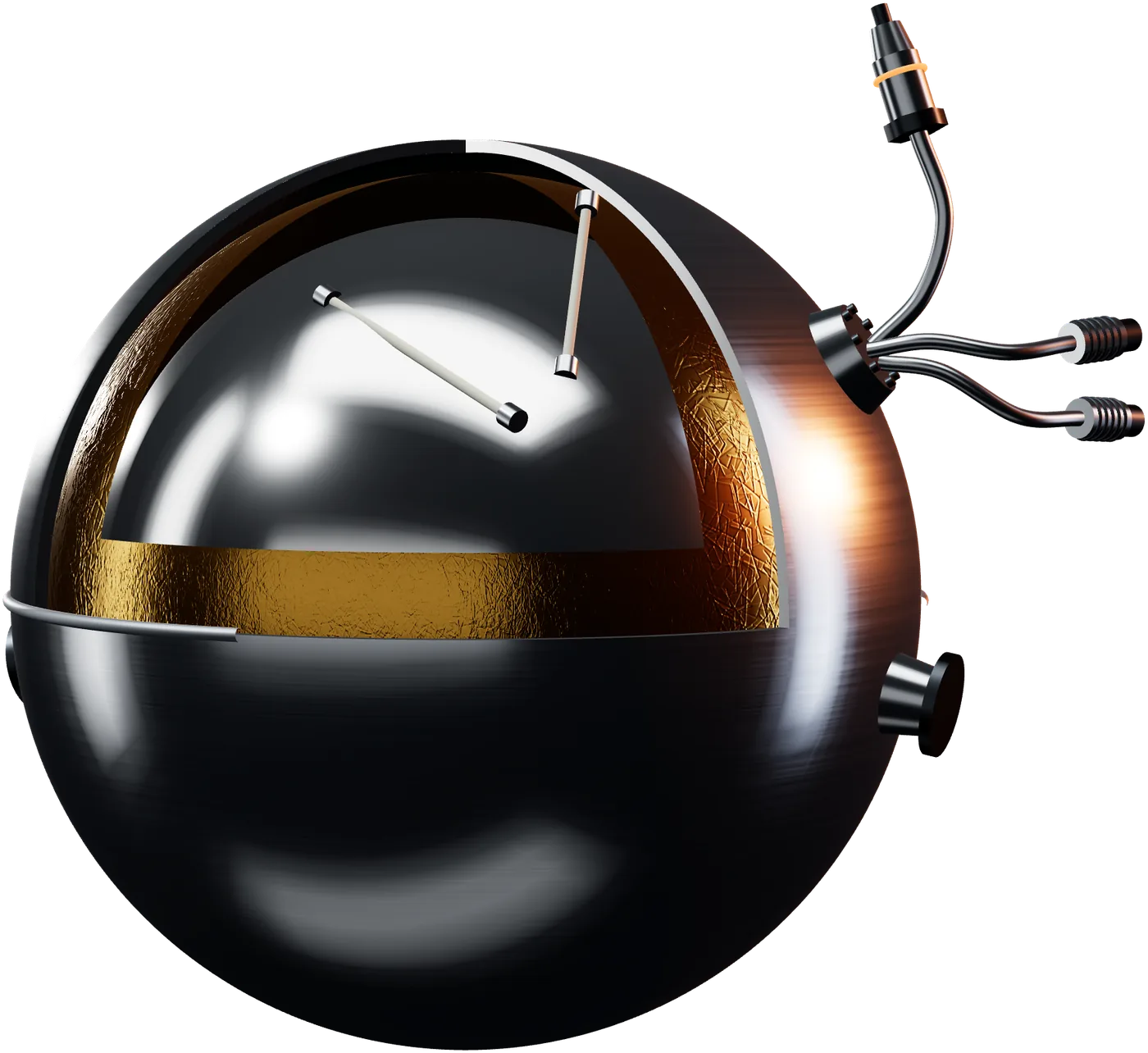
21 failure modes. 6 critical. The other 10 sit in parts this view hides: heaters, sensors, the vacuum pump and the supply line.
- Relief valve 3 modes, 2 critical
- Quick disconnects 3 modes, 1 critical
- Straps 3 modes, 1 critical
- Inner vessel 1 mode, critical
- Insulation 1 mode
Render for illustration. Counts from the sample report. Replay sped up: the real run took 22 minutes 58 seconds.
- Read the inputs9 functions with their environment, materials and interfaces
- Draft failure modes21 modes, each with an effect chain and causes
- Score every modeSeverity, occurrence and detection, each citing a rubric row
- Audit the draft18 checks for common FMEA mistakes
- Print its own correctionsFixes from the audit stay visible in the report
Scoring
Every score shows its work
Open any row and see why it scored the way it did: the rubric row behind each number, and what the draft couldn't know.
S9 Loss of vehicle, no public risk; or loss of crew
O5 Engineering judgment, no test data
D5 Seen in flight on pressure telemetry, no automated response
- S9 cites its rubric row. Every severity, occurrence and detection score points at the row of the scale it used.
- O5* is judgment, and says so. With no test history, occurrence never goes below O4 in a design FMEA. The star marks a score without data, and only the engineer can go lower.
- D5 credits a real control. Detection credit comes only from controls that exist. D3 or better needs a verified one.
- Critical has a rule. Severity 9 or higher, or RPN 200 or higher with data-backed occurrence. Anything else that scores high is marked provisional, and no failure rate prints without data.
Staying current
Change one input. Only what rested on it goes stale.
Every claim records the inputs it rests on. In the demo project, a fictitious LOX valve, one seat material change flagged 74 of 345 claims. The other 271 stayed current.
Illustration based on the demo project. The claim wording is a summary.
Benchmark
Graded against NASA's 1988 review
The answer key is NASA-CR-185545, the independent review of the orbiter's power reactant storage system. It lists 14 distinct failure modes for the hydrogen tank. The key was written down first, then the same inputs ran three times.
| PRSD | 200 | 201 | 202 | 203-205 | 206 | 207 | 208 | 209 | 210 | 211 | 212 | 213 | 214/215 | 216 | Result |
|---|---|---|---|---|---|---|---|---|---|---|---|---|---|---|---|
| Run 1 | 200: Fully matched | 201: Partly matched | 202: Fully matched | 203-205: Missed | 206: Fully matched | 207: Fully matched | 208: Fully matched | 209: Fully matched | 210: Fully matched | 211: Fully matched | 212: Fully matched | 213: Missed | 214/215: Fully matched | 216: Partly matched | 10 full, 2 partial, 2 missed |
| Run 2 | 200: Fully matched | 201: Partly matched | 202: Fully matched | 203-205: Missed | 206: Fully matched | 207: Fully matched | 208: Fully matched | 209: Fully matched | 210: Fully matched | 211: Fully matched | 212: Fully matched | 213: Fully matched | 214/215: Fully matched | 216: Partly matched | 11 full, 2 partial, 1 missed |
| Run 3 | 200: Fully matched | 201: Partly matched | 202: Fully matched | 203-205: Missed | 206: Fully matched | 207: Fully matched | 208: Fully matched | 209: Fully matched | 210: Fully matched | 211: Fully matched | 212: Fully matched | 213: Missed | 214/215: Fully matched | 216: Partly matched | 10 full, 2 partial, 2 missed |
Swipe sideways to see all 14 failure modes and the totals.
The display pressure sensor (203 to 205). The draft credited it only as a detection control.
The relief valve external leak (213), rated criticality 1/1 in both NASA's analysis and the independent one.
The quick disconnect (201), covered when mated but not at mate and demate, and a leak into the vacuum annulus (216).
The demo run added 9 modes the review didn't list, such as insulation, strap fracture and vacuum degradation. Each one still needs an engineer's judgment.
Sign-off
Your engineer signs every line
Accept, edit or reject each row. At CDR, TRR or LRR, sign-off takes a typed name and zero pending rows. The tool never signs: it records who did and keeps a snapshot, so the next review only shows what changed.
Sample report
Files your reviewers already read
Every draft exports as a PDF marked DRAFT until sign-off, and as a CSV for your own tools. The hydrogen tank report is public.
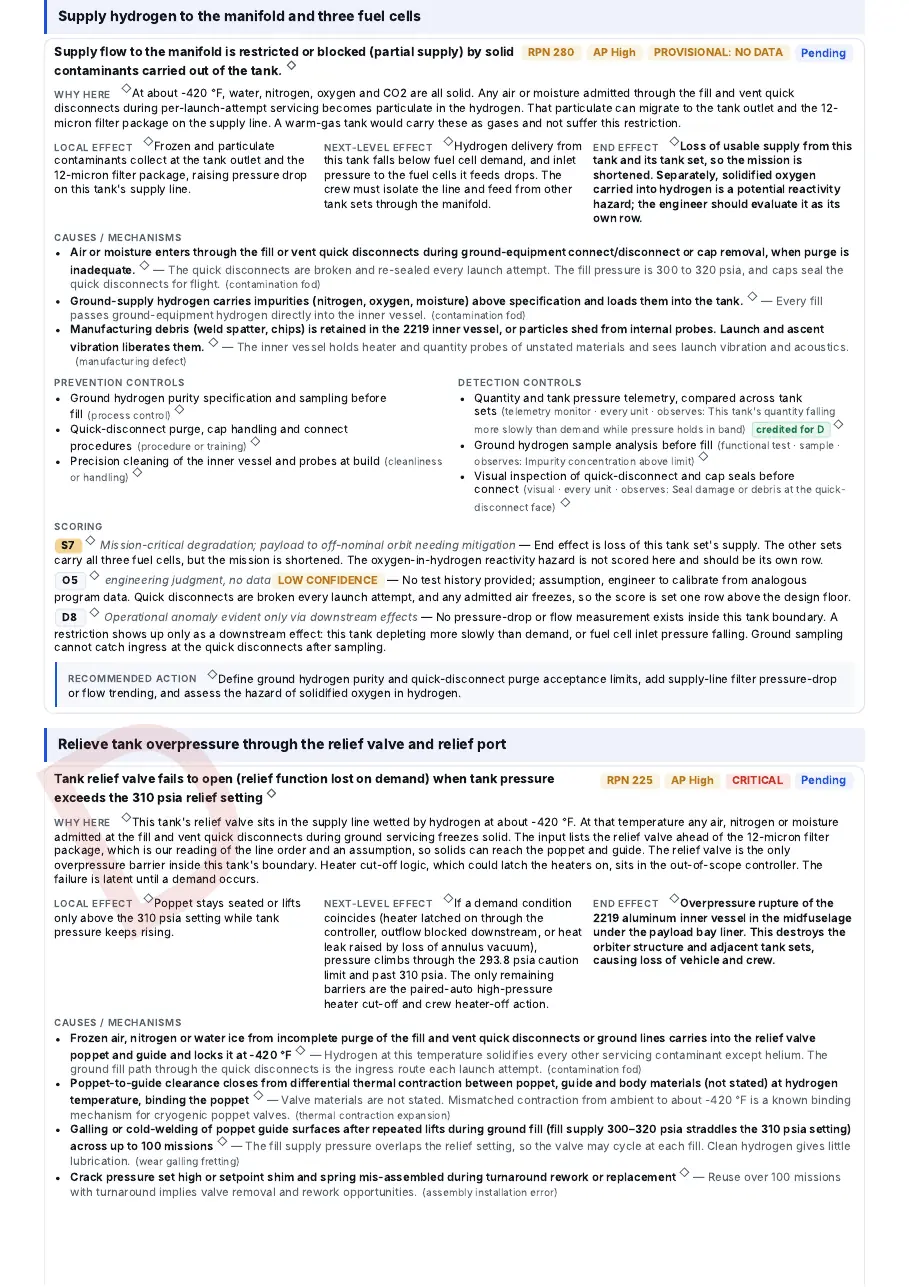
PDF report
Effect chains, causes and scores for all 21 failure modes, as drafted. Page 9 is the relief valve.
43-column CSV
Every row with its scores, causes, controls and disposition, ready for a spreadsheet or your own tracker.
Free starting FMEA
Send us one part
Describe it in a few lines. You get a drafted FMEA back within a few days for your team to review. No sales call.
Your email is ready
Your email app should have opened with the request filled in. Press send there.
Nothing opened? Copy the request and email it to .